
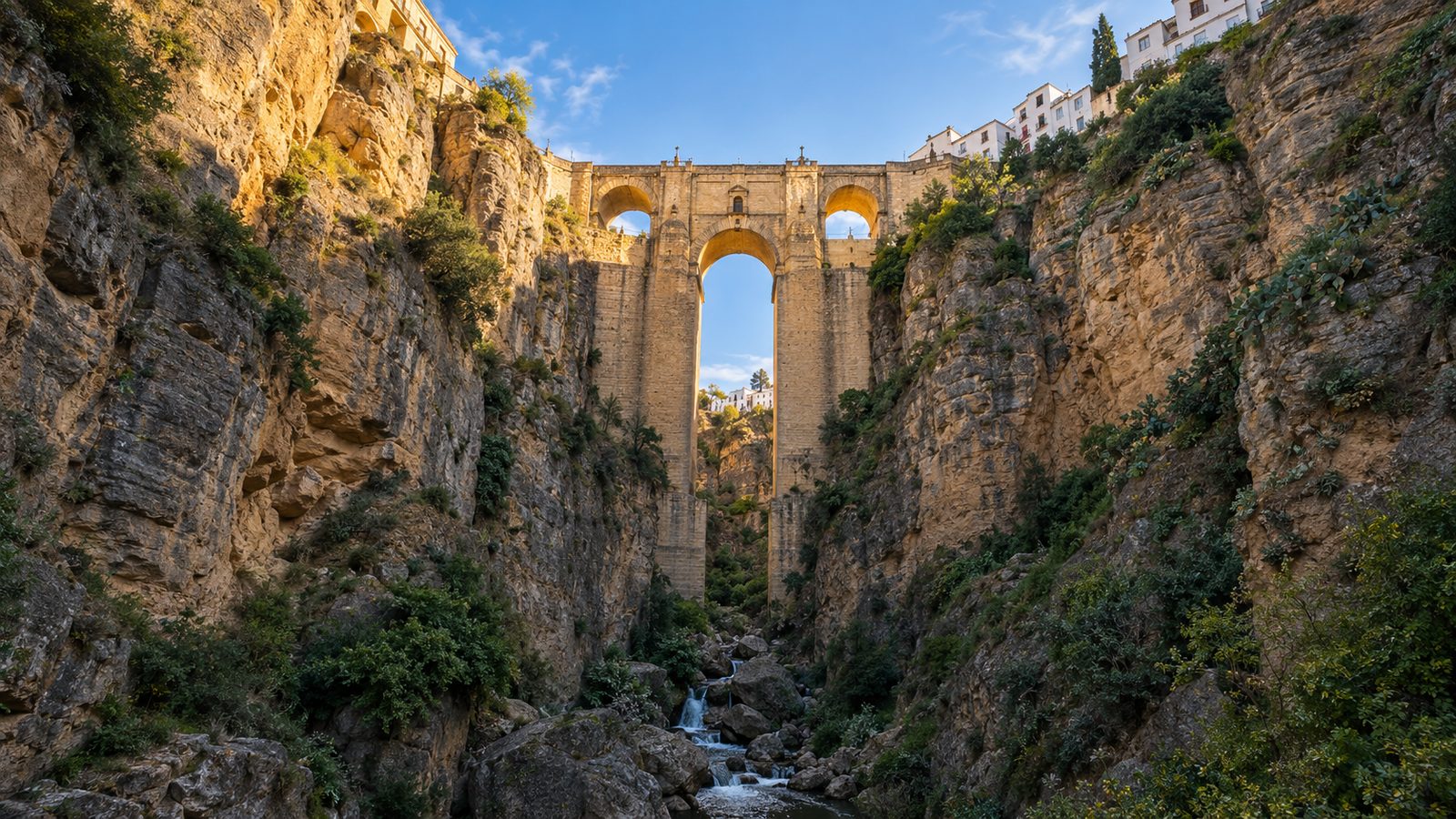
Ronda sits on a rock split in two by a gorge. The two halves of the town are joined by the Puente Nuevo, a bridge hanging 98 metres above the floor of the El Tajo canyon. It took forty-two years to build, and it is still the most photographed view in Andalusia.
Malaga to Ronda by car takes an hour and a half. You have two routes to choose from: the quicker one via Ardales and the scenic one through the mountains above Marbella. Below we break down both and list seven car parks with actual prices, two of them free. There is also a six-hour plan that gets you back to the coast in time for dinner.
In this article:

The town stands on a plateau that the Guadalevín river has sliced open, leaving a gorge close to a hundred metres deep. On one side is La Ciudad, the Moorish old town. On the other is the newer El Mercadillo. For centuries two lower bridges were the only link between them. The Puente Nuevo, which simply means “new bridge”, was not finished until 1793.
The second reason is bullfighting. The Plaza de Toros dates from 1785 and is regarded as the cradle of modern bullfighting. That means the kind fought on foot, with the “muleta” (small red cape). Its ring measures 66 metres across, the largest in the world, and the stands hold five thousand spectators.
The third reason is more literary. Hemingway and Orson Welles both spent a good deal of time here. A scene in “For Whom the Bell Tolls” is thought to be modelled on Ronda. Rilke wrote that he had searched everywhere for the city of his dreams and found it here. Today one of the town's car parks carries his name. That may be the most practical monument a poet could hope for.
The quicker and easier of the two. You leave Malaga heading west on the A-357 and pass Cártama and Pizarra. Near Ardales you switch to the A-367, which takes you straight into Ronda.
The road is wide, dual carriageway for most of the way, and toll-free. The last 30 kilometres wind through the hills, but these are gentle curves, not hairpins.
This route has one more advantage: it runs past the Caminito del Rey. If you want to fit both into one trip, directions and tickets are covered in our guide to the Caminito del Rey.

Prettier, and twenty minutes longer. You follow the coast on the A-7, or the AP-7 toll motorway, as far as San Pedro Alcántara. From there you turn uphill on the A-397.
This stretch is one of the most beautiful roads in Spain. Hairpins climb through the Sierra de las Nieves, a national park. You pass viewpoints with the sea far below and, on a clear day, the outline of the Moroccan coast.
If you have the whole day, the best set-up is out on the A-357, back on the A-397. You see both landscapes and never drive the same road twice.
Parking in Ronda is surprisingly easy for a town of this size. There are even free options within sensible walking distance.
| Car park | Spaces | To the Puente Nuevo | Notes |
|---|---|---|---|
| San Cristóbal (Avenida Ricardo Navarrete) | about 50 | about 15 min on foot | concrete surface, open round the clock |
| Plaza Pruna | about 40 | about 10 min on foot | tarmac, popular with motorhomes, open round the clock |
| White-line bays on Avenida Málaga and Avenida Andalucía | varies | 10 to 20 min | full before 11:00 in high season |
| Car park | Per hour | Per day |
|---|---|---|
| Martínez Astein | €1.95 | €13.95 (via the app) |
| La Concepción | €1.80 | free from 22:00 to 8:00 |
| El Castillo | €2.20 | €18.15, first 59 minutes free |
| Plaza del Socorro | €2.40 | €18.70 |
| Poeta Rilke | €2.40 | €25.00 |
El Castillo offers the best balance of price and location, mainly thanks to that free first hour. If Ronda is a quick detour for one photo of the bridge, you will drive out without paying a cent.
For a full day of sightseeing, Martínez Astein via the app is the cheapest, at €13.95 per day. And if you do not mind a quarter-hour walk, San Cristóbal is free and usually has spaces, even in July.

10:00 to 10:45, the Puente Nuevo and the viewpoints. Start with the bridge, before the coaches arrive. Walk across, then take the path down towards the Mirador de Aldehuela, where you see the whole structure side-on. The best photos are taken from below, not from above.
10:45 to 11:45, the Plaza de Toros and the Museo Taurino (bullfighting museum). Tickets cost €10.00, or €12.00 with an audio guide. That gets you into the ring, the stables and the museum, with matador costumes from two centuries. Opening hours: 10:00 to 20:00 from April to September, until 19:00 in October and March, until 18:00 from November to February.
11:45 to 12:30, the Alameda del Tajo gardens. A park on the lip of the gorge, with viewing balconies hanging right over the drop. Shade and benches, a good place to catch your breath before lunch.
12:30 to 14:00, La Ciudad, the old town. Cross the bridge to the other side. Here you will find the Palacio de Mondragón, the church of Santa María la Mayor and the Arab baths, among the best preserved in Spain.
14:00 to 15:30, lunch. Details below.
15:30 to 16:30, a walk along the walls and the drive back. Or add Setenil, if you have time to spare.
The restaurants overlooking the gorge have the best views and the worst value for money. You are paying for the panorama.
Walk three streets away from the Puente Nuevo, towards Plaza del Socorro or deeper into the San Francisco quarter. Prices drop by a third and the food gets better. Look for a board advertising the “menú del día” (set lunch): two courses, dessert, bread and a drink for €12 to €16.
The local speciality is “rabo de toro”, oxtail braised for hours in red wine. A heavy, no-nonsense dish, and a classic in a bullfighting town. The local wine goes well with it. A dozen or so wineries work the land around Ronda, and the Sierras de Málaga appellation turns out some very decent reds. That part is for the passengers, or for a bottle to take home. The driver stays on water.
Setenil de las Bodegas, 20 km, about 25 min. A village where the houses are built in under an overhanging rock. It is the most distinctive place in the whole area and a natural add-on to a trip to Ronda. We cover the white villages route in a separate guide.
Acinipo (Ronda la Vieja), 20 km, about 25 min. The ruins of a Roman town with a surviving theatre, on a hilltop looking out over the whole valley. Entry is free, but check the opening days first. It is sometimes open only on certain days of the week.
Cueva del Gato, 20 km towards Benaoján. A cave with a stream flowing out of it into a natural pool. It gets crowded in summer. The water is cold, in the teens even in the hottest weather, and after a day in the heat it is quite a shock.
| Distance from Malaga | 110 km (A-357) or 130 km (A-397) |
| Driving time | about 1 hr 30 min or about 1 hr 50 min |
| Tolls | none on the A-357, optional AP-7 on the Marbella route |
| Fuel, there and back | about €21 to €25 |
| Parking | from €0 (San Cristóbal) to €25 per day |
| Plaza de Toros ticket | €10.00 or €12.00 with an audio guide |
| Time for sightseeing | 4 to 6 hours |
| Height of the Puente Nuevo | 98 m above the floor of the gorge |
About 110 km (68 miles) on the A-357 and A-367 via Ardales, or about 130 km on the A-397 through the mountains above Marbella. The drive takes 1 hour 30 minutes or 1 hour 50 minutes respectively.
The quickest way is west on the A-357, then the A-367 from Ardales. The route is toll-free, wide and has no hairpins. The scenic option follows the coast to San Pedro Alcántara, then climbs the A-397 through the Sierra de las Nieves.
4 to 6 hours for the classics: the Puente Nuevo, the Plaza de Toros, the Alameda gardens and La Ciudad, the old town. With lunch and the drive both ways, that makes a full day.
For free at the San Cristóbal car park (15 minutes on foot) or at Plaza Pruna (10 minutes). The cheapest paid option is Martínez Astein, €13.95 per day via the app. For a short stop use El Castillo, where the first 59 minutes are free.
€10.00 for a standard ticket and €12.00 with an audio guide. The price covers the ring, the stables and the bullfighting museum.
Not on the A-357, which is a wide road with no tolls and no hairpins. The A-397 needs more attention, with dozens of tight bends and stretches without crash barriers. It is not technically hard, though.
Yes. You can walk round the town in a few hours, and the drive takes an hour and a half each way. If you have time left over, add Setenil de las Bodegas, 25 minutes away.
Yes, but it is slower than driving. Buses from Malaga do run, though not often, and the train takes a roundabout route. With a car you set your own hours and can add Setenil or Acinipo along the way.
Route chosen, car park picked, plan ready. All that is left is the car. At Car4Rent Malaga you rent with no deposit and no credit card, with service in English or Polish around the clock. We bring the car to the airport terminal, or to your hotel as a paid extra, and the paperwork takes 15 to 20 minutes. Mileage within Andalusia is unlimited, so going out on the A-357 and back on the A-397 adds nothing to the bill.
➤ Check availability and prices
See also:
 Contact phone number/Whatsapp:
 E-mail:
 Opening hours:


