
Driving in Spain is not wildly different from driving at home. The road signs look familiar and the rules follow the same logic as the rest of Europe. Coming from the UK or Ireland? The one big switch is driving on the right. Everything else is detail, and the detail is where it gets expensive: tight speed camera tolerance, colour-coded parking and steep fines for small slips.
We put this guide together from our team's day-to-day experience in Malaga. It covers the road rules that matter most when driving in Spain, correct as of 2026. The focus is on what really is different and what catches visiting drivers out. Still planning the trip? Have a look at car rental in Malaga with no deposit, so nothing gets blocked on your card.
Road type |
Limit (cars) |
UK limit for comparison |
Fine for 20 km/h over |
Built-up area (“poblado”), two or more lanes each way |
50 km/h |
30 mph (48 km/h) |
€100 |
Single carriageway road (“carretera convencional”) |
90 km/h |
60 mph (97 km/h) |
€100 |
Motorway (“autopista” or “autovía”) |
120 km/h |
70 mph (113 km/h) |
€100 |
30 zone (“zona 30”), most town streets with one lane each way |
30 km/h |
20 mph zones (32 km/h) |
€100 |
The number to remember: the motorway limit in Spain is 120 km/h, roughly 75 mph. That is a touch above the UK's 70 mph, but below the 130 km/h allowed in France or Italy. Drivers who cruise at 130 to 140 km/h out of habit get fined. Spanish speed cameras leave very little room: 7 km/h at speeds up to 100 km/h and 7% above 100 km/h. In practice, at a 120 km/h limit the fine arrives from about 129 km/h.
How much? Up to 20 km/h over the limit in town, or up to 30 km/h over on the open road, costs €100. Go beyond that and the fine jumps to €300, then keeps climbing.
Tip: Set the cruise control to 118 km/h on the motorway and forget the stress. That is a safe margin.
A “zona azul” (blue zone) is paid parking marked with blue lines on the road. You will find one in the centre of most towns along our scenic routes on the Costa del Sol. The rules are simple: buy a ticket at the machine (coins or card), put it behind the windscreen and watch the clock. Typical price: €0.80 to €1.50 per hour. Maximum stay: usually 2 hours.
More and more towns let you pay with a mobile app (EasyPark, Telpark). Download one of them before you travel.
In central Malaga and Marbella, underground car parks are the easiest option (about €1.50 to €2 per hour). In small towns such as Mijas, Frigiliana and Ronda, look for free car parks on the edge of town. The centres are often closed to traffic.
The basic rule is the one you already know: vehicles on the roundabout have priority. If you drive on the left at home, picture the mirror image. Traffic flows anticlockwise and you give way to cars coming from your left. Watch out on multi-lane roundabouts, because local drivers often change lanes without indicating. Stay sharp in Malaga and Marbella, where roundabouts can be large and built on several levels.
Tip: Not sure about your exit? Keep to the right-hand (outer) lane. You can always go round once more.
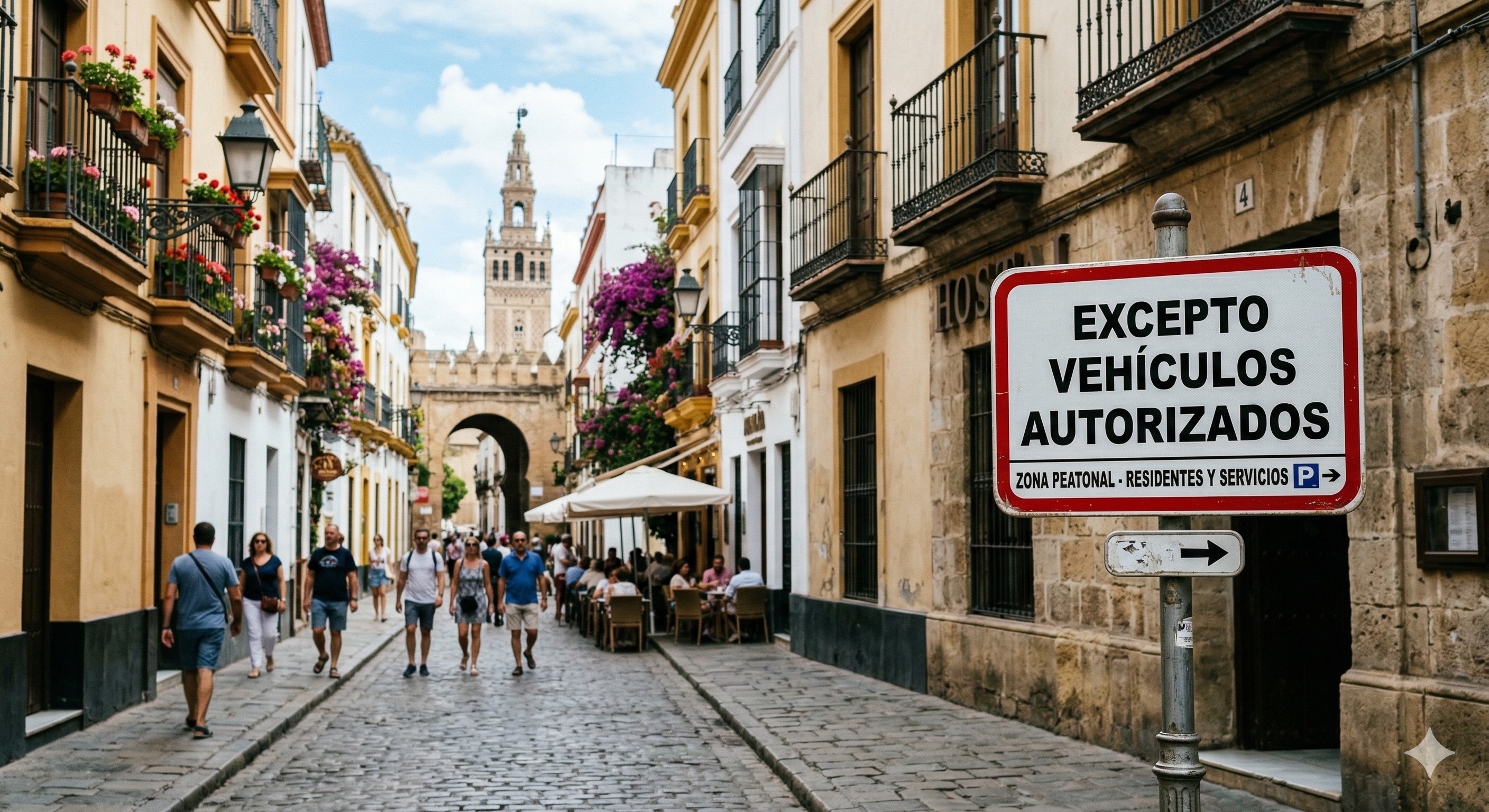
Driving through Spanish towns, you may meet a no-entry sign with the words “Excepto autorizados” (authorised vehicles only) or “Excepto residentes” (residents only). It means only vehicles with a special permit may drive in. As a rule that covers residents of that street, municipal services and delivery drivers at set hours.
These zones are mostly found in historic centres, on narrow streets and in districts with restricted traffic. Entry is often watched by number plate cameras, and drivers without a permit are fined automatically.
A rental car has no such permit, so you must not drive in. Fines usually run from about €50 to €100, and some cities charge even more.
Our advice: when you see “Excepto autorizados” or “Excepto residentes”, stay out. There is almost always a public or underground car park nearby, and the centre is a short walk away. You save money and a good deal of stress.
The legal limit in Spain is 0.5 g/l of alcohol in blood (0.25 mg/l in breath). Held your licence for less than 2 years? Then your limit is 0.3 g/l (0.15 mg/l). On the Costa del Sol the police breath-test drivers often. Especially at weekends and in summer.
| Breath reading | Penalty |
|---|---|
| 0.25 to 0.50 mg/l | €500 fine |
| over 0.50 mg/l | €1,000 fine |
| from 0.60 mg/l (1.2 g/l in blood) | criminal offence: a court case and a driving ban |
The table covers the general limit. Had a drink driving fine in the last year? The next one is always €1,000.
Our advice? In a rental car, zero alcohol behind the wheel, no exceptions. How a roadside check works and what alcohol does to your insurance is covered in a separate guide: drink driving in Spain.
Remember! Car4Rent Malaga has a zero alcohol rule. Driving under the influence is forbidden, whatever the reading. If a driver under the influence causes an accident, the car's insurance is void and the driver pays for all the damage.
In Spain every child under 135 cm tall must travel in a child car seat, and in the back. The front seat is allowed only in a two-seater, or when the back seats are already taken by other child seats. Spain's traffic authority (DGT) recommends a seat or booster until 150 cm. The fine for travelling without one starts at €200.
Car4Rent Malaga rents child seats for babies, toddlers and older children (booster). They cost €10 to €15 for the whole rental, not per day. Add one when you book the car and it will be fitted and waiting at pick-up.
Most motorways in Andalusia are free, which is great news for your budget. An “A” number (A-7, A-45) means a free road (“autovía”). An “AP” number (AP-7, AP-46) means a toll road (“autopista”).
On the Costa del Sol only two tolls really matter. The AP-46 runs north from Malaga towards Antequera, Granada and Cordoba and costs up to about €7. The AP-7 has toll sections along the western coast. The A-7 runs parallel and is free, just a little slower.
Quick guide: AP = “autopista” (toll), A = “autovía” (free). Memory aid: P is for “pagar” (to pay).
In a collision with a rental car: stop somewhere safe, switch on the hazard lights and put on the reflective vest before you get out. The vest is compulsory in Spain whenever you step out on a road outside town. Then place the V16 emergency beacon on the roof. Since 1 January 2026 this flashing light has replaced the warning triangle in Spanish-registered cars, rental cars included. Call 112 and the Car4Rent assistance number (open 24/7).
Car4Rent Malaga cars are equipped as Spanish law requires. Check at pick-up where the vest and the beacon are kept.
Do not admit fault at the scene and do not sign documents you do not understand. Take photos of the scene. The Car4Rent team will help you with the paperwork in English or Polish.
Do they drive on the right in Spain?
Yes. Spain drives on the right and overtakes on the left, the opposite of the UK and Ireland. Your rental car has the steering wheel on the left.
Can I use my phone as a sat nav?
Yes, but the phone has to sit in a holder. Holding it in your hand while driving means a €200 fine plus 6 licence points.
Can I drive in Spain on a UK licence?
Yes. A UK photocard licence is valid for visits to Spain and you do not need an International Driving Permit. Licences from Ireland and other EU countries are fine too.
See also:
You know the rules now, so the fun part can start. Rent a car from Car4Rent Malaga with optional full cover and 24/7 support. No deposit, no credit card, service in English or Polish.
 Contact phone number/Whatsapp:
 E-mail:
 Opening hours:


