
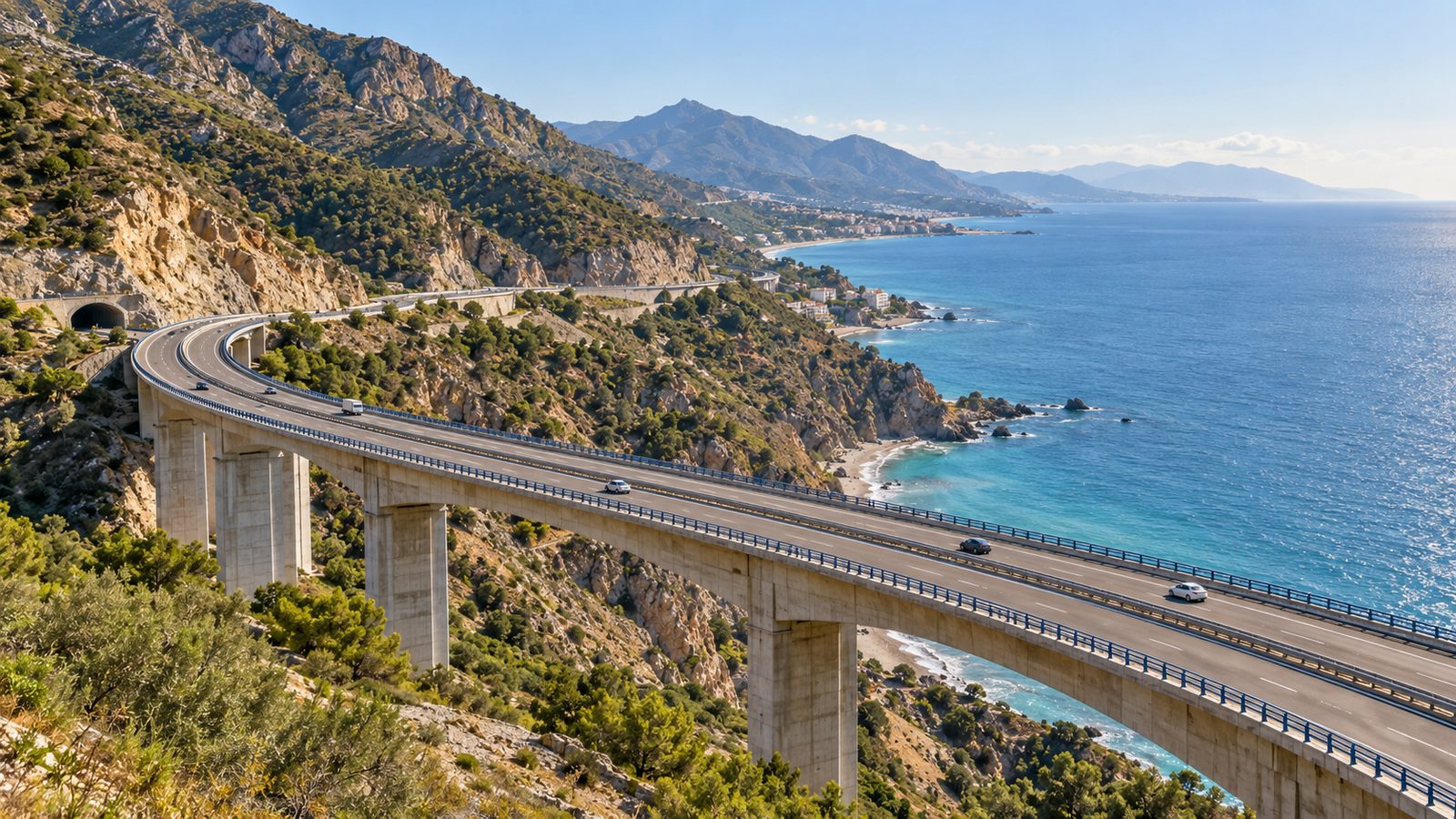
One letter decides whether you pay. The A-7 is free. The AP-7 is not. Both run along the Costa del Sol, in places side by side, a few hundred metres apart. Your sat nav rarely warns you which one you are about to join.
In peak season, driving the AP-7 from Malaga to Manilva and back costs €39.10 in tolls alone. For one day on the road. The good news: toll roads in Spain are the exception these days, and the whole of Andalusia has just two left. You can drive around both. Below you get the rates to the cent, a rundown of where you pay, and whether a toll tag makes sense for a two-week holiday.
In this article:

The rule is simple, and it works across the whole country.
Before every tolled section there is a sign showing the price. It is large, yellow and black, and gives the amount to the next toll booth. If you can see it, you still have one exit left to the free alternative.
Two toll motorways operate in the whole region today. That is all.
AP-7, the Autopista del Sol. It follows the coast from Malaga past Marbella and Estepona to Guadiaro, near Sotogrande. Of all the toll roads in Andalusia this is the one tourists use most, because it leads exactly where the resorts are.
AP-46, the Las Pedrizas motorway. A short stretch between Malaga and Antequera that skips the hairpin bends of the old road through Casabermeja. You use it heading north from Malaga, towards Seville, Cordoba or Granada.
Everything else is free. That means the A-7 along the coast, the A-45 to Cordoba and the A-92 to Seville and Granada. The same goes for the A-44 to Jaén, the A-357 towards Ronda and the A-4 from Cordoba to Seville. Even the AP-4 from Seville to Cadiz stopped charging when its concession ran out. Touring the “pueblos blancos” (white villages), visiting the Caminito del Rey, following the coast to Nerja: none of it costs a cent in tolls.
The AP-7 has two price lists. Normal season runs from October to May. High season covers June to September, plus seventeen days around Easter. The difference is as much as 60 per cent.
| Section | Normal season | High season |
|---|---|---|
| Malaga to Calahonda | €3.55 | €5.75 |
| Calahonda to Marbella | €3.55 | €5.75 |
| Malaga to Marbella (total) | €5.70 | €9.25 |
| Marbella to San Pedro Alcántara | €2.20 | €3.60 |
| San Pedro Alcántara to Estepona | €2.20 | €3.60 |
| Marbella to Estepona (total) | €3.85 | €6.25 |
| Estepona to Manilva | €1.20 | €2.00 |
| Manilva to Guadiaro | €1.20 | €2.00 |
Driving the full route from Malaga to Manilva in July costs €19.55 one way. There and back, €39.10. Over a week of daily outings that adds up to roughly the price of a few days of car rental.
The AP-7 concession runs until 2054, so do not count on a free ride along the Costa del Sol any time soon.
The AP-46 links Malaga with Antequera and feeds into the A-92. The full stretch costs €4.35 in normal season and €6.60 in high season.
There is a twist, though, that hardly anyone knows about.
Between midnight and six in the morning cars use the AP-46 free of charge, every day of the year. Handy for a late landing or a dawn start towards Granada.
The daytime alternative is the old A-45 through Casabermeja. It costs nothing, but it winds up to the Las Pedrizas pass and can be unpleasant in fog or strong wind. It adds 10 to 15 minutes.

Spanish toll booths are easy, as long as you pick the right lane. The signs above each lane tell you which is which.
Visa and Mastercard cards from the UK, Ireland and the rest of Europe work without a problem. The terminal asks for your PIN or takes a contactless tap.
There is no ticket on the Costa del Sol AP-7. It is an open system: you pay a fixed amount at each toll plaza you pass. There are three between Malaga and Guadiaro: Calahonda, San Pedro de Alcántara and Manilva. Malaga to Marbella means one plaza (Calahonda), Marbella to Estepona a second (San Pedro).
VIA-T is Spain's electronic toll system. You fix a tag behind the rear-view mirror, drive through a separate lane without stopping, and the toll comes off your account.
For a tourist the sums rarely add up. The tag needs a contract with a provider, a monthly or annual fee and a bank account. The discounts it brings are aimed at regular users, people who drive the same stretch dozens of times a quarter.
On a two-week holiday with a handful of toll booths you would save a few euros. The paperwork would take longer than the queue. Pay by card and keep it simple.
There is one exception. The AP-7 gives discounts to “regular users”, defined as 60 journeys in four months. If you come to the Costa del Sol often and drive this route every day, the question comes back. On a normal holiday it does not.
| Route | Road | Tolls (high season) | Free alternative |
|---|---|---|---|
| Malaga Airport to Marbella | AP-7 | €9.25 | A-7, about 20 min longer |
| Malaga Airport to Fuengirola | AP-7 to Calahonda | €5.75 | A-7, about 10 min longer |
| Malaga to Seville | AP-46 + A-92 | €6.60 | A-45 via Casabermeja, about 15 min longer |
| Malaga to Gibraltar | AP-7 to Guadiaro | about €19.55 | A-7, about 40 min longer |
| Malaga to Ronda | A-357 | €0 | the route is toll-free |
The simplest rule: on the short hops to Fuengirola and Marbella the AP-7 is rarely worth the money. The A-7 runs alongside and is only a little slower. On the long run to Gibraltar or Sotogrande the toll road saves a real 40 minutes and a fair bit of stress. Down there the A-7 goes through every town in turn.
This is where it gets more interesting, because the rules stop being so convenient.
The rest of Spain. Tolled sections are scattered mainly across the north and east, around Barcelona, Bilbao and Valencia. Some of them run a closed system: ticket on the way in, payment on the way out, cards accepted everywhere. Many former “autopistas” went toll-free when their concessions expired, so a toll map from 2015 is out of date.
Portugal. This is the real trap. Some Portuguese motorways charge electronically only, with no booths and no way to pay cash. A camera reads your number plate, much like the Dartford Crossing in England. The bill goes to the owner of the vehicle, which means the rental company. It then adds a handling fee to your bill, sometimes months after you have flown home.
Unlimited mileage applies within Andalusia. A trip to Madrid, Valencia or Lisbon is something to agree when you book, not a decision to make on the road.
Driving into a VIA-T lane without a tag. The barrier stays down, a queue builds and you have to call staff on the intercom. Look at the symbols above the lane, not the lane number.
Looking for a ticket on the AP-7. There are no tickets on the Costa del Sol, you pay a fixed amount at the plaza. You do get an entry ticket on some toll motorways elsewhere in Spain. There, tuck it behind the sun visor as soon as you take it.
Trusting the sat nav without switching on “avoid toll roads”. The default is the fastest route, which means through the toll booths. You change it once, before you set off.
Mixing up the A-7 and the AP-7 at a junction. The slip roads can be close together and signed alike. Look for the letter P.
Assuming all of Spain charges tolls. In Andalusia the vast majority of fast roads are free. You pay only on the AP-7 and the AP-46.
€5.70 in normal season (October to May) and €9.25 in high season (June to September plus the Easter period).
Yes. The A-7, or Autovía del Mediterráneo, runs along the coast parallel to the AP-7 and charges nothing. It is slower, with more junctions and built-up stretches.
No. You can pay at the booth by card or cash. The VIA-T tag lifts the barrier without stopping but needs a contract with a provider, so it rarely pays off for one holiday.
Yes. Visa and Mastercard are accepted in the staffed lanes and at the machines. Cash works too, but not every machine gives change.
Yes. For cars, driving it between midnight and six in the morning is free every day of the year.
Only two: the AP-7 along the Costa del Sol from Malaga to Guadiaro, and the AP-46 between Malaga and Antequera. All the rest, including the A-92, A-45, A-44, A-357 and A-4, are free.
Rarely. In high season the toll is €9.25 and it saves about 20 minutes over the free A-7. On the long run to Gibraltar the saving is about 40 minutes, which is easier to justify.
You now know where you pay and how to get round it. At Car4Rent Malaga you rent with no deposit and no credit card, with support around the clock in English or Polish. We bring the car to the airport terminal or, for an extra fee, to your hotel, and the paperwork takes 15 to 20 minutes. Mileage within Andalusia is unlimited, so taking the free A-7 costs you nothing but a quarter of an hour.
➤ Check availability and prices
See also:
 Contact phone number/Whatsapp:
 E-mail:
 Opening hours:


