
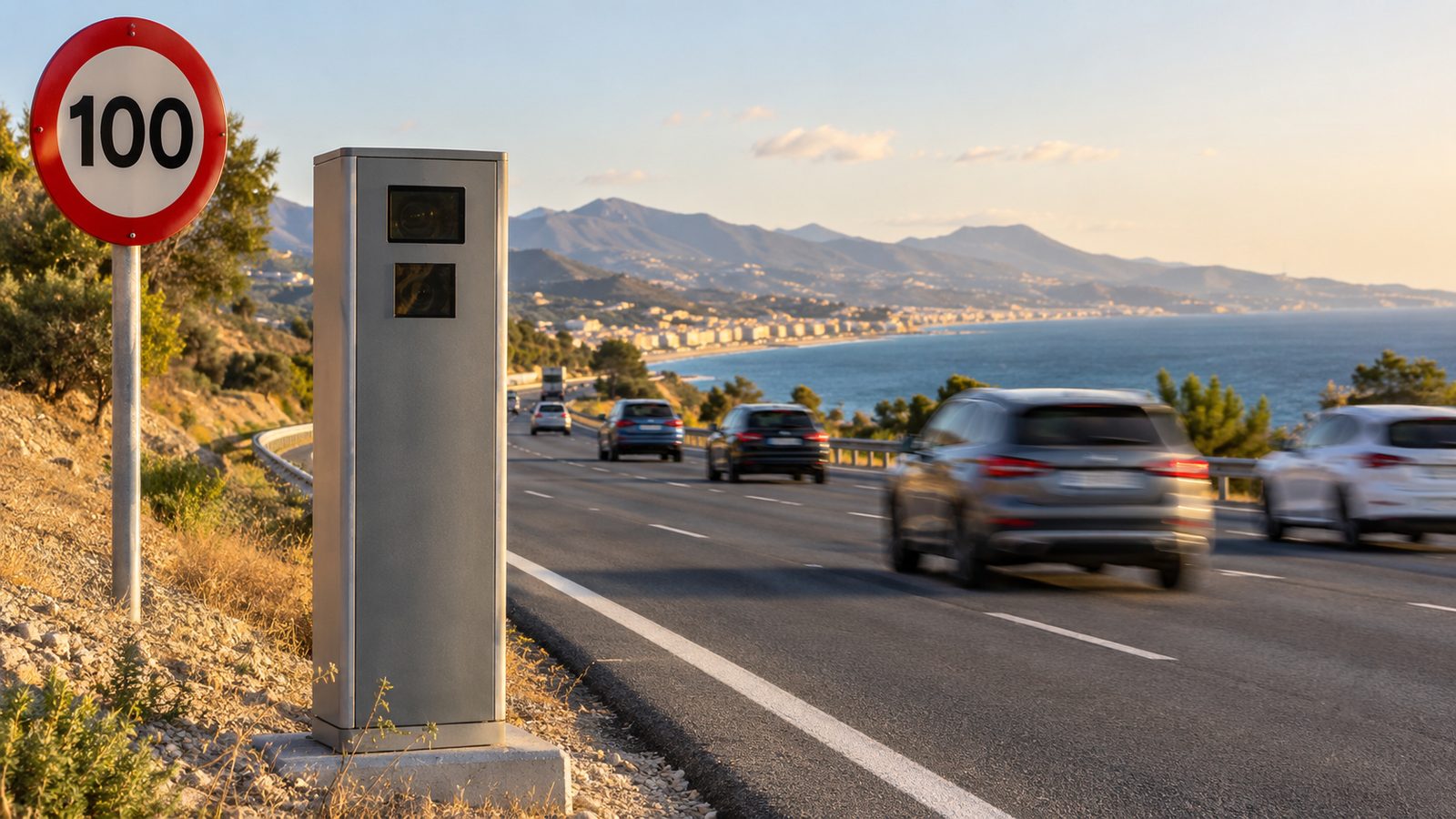
Traffic fines in Spain come with no tourist rate. The speed camera on the A-7 does not care that you are in a rental car, only how far over the limit you were. The amounts are set by law and identical across the country. The classic holiday offence, a dozen or so km/h too fast on the motorway, costs €100. Or €50 if you pay within 20 days.
The bigger question is what happens next. A speed camera fine goes to the rental company first, then to your home address, sometimes months later. Below you will find the 2026 rates, the DGT speeding bands, parking rules in Malaga and four ways to pay from abroad. Plus a straight answer on whether a fine from Spain can be ignored.
In this article:
The rates come from Spain's traffic law (“Ley de Tráfico”) and the catalogue of the DGT, the Dirección General de Tráfico (Spain's traffic authority). Correct as of September 2026:
| Offence | Fine | Points | With the 50% discount |
|---|---|---|---|
| Speeding up to 30 km/h over the limit outside towns (up to 20 km/h in town) | €100 | 0 | €50 |
| Phone in your hand | €200 | 6 | €100 |
| No seat belt | €200 | 4 | €100 |
| No child car seat (per child) | €200 | 4 | €100 |
| Red light or STOP sign | €200 | 4 | €100 |
| Alcohol 0.25 to 0.50 mg/l | €500 | 4 | €250 |
| Alcohol over 0.50 mg/l | €1,000 | 6 | €500 |
| Drugs (saliva test) | €1,000 | 6 | €500 |
| Illegal parking (“grave”, a serious offence) | usually €200 | 0 | €100 |
Most “ordinary” offences are a round €200. The 50% discount (“pronto pago”, prompt payment) covers almost every fine. Points apply to Spanish licences, and we will come back to that.

The limits are in our guide to traffic rules in Spain. In short: 120 km/h on motorways, 90 km/h on ordinary roads, 50 km/h in town. The fine depends on how far over the limit you were. These are the bands from Annex IV (“Anexo IV”) of the traffic law:
| Limit | €100 / 0 pts | €300 / 2 pts | €400 / 4 pts | €500 / 6 pts | €600 / 6 pts |
|---|---|---|---|---|---|
| 50 km/h | 51 to 70 | 71 to 80 | 81 to 90 | 91 to 100 | over 100 |
| 90 km/h | 91 to 120 | 121 to 140 | 141 to 150 | 151 to 160 | over 160 |
| 100 km/h | 101 to 130 | 131 to 150 | 151 to 160 | 161 to 170 | over 170 |
| 120 km/h | 121 to 150 | 151 to 170 | 171 to 180 | 181 to 190 | over 190 |
In practice: you are doing 130 km/h on a stretch of the A-7 with a 100 km/h limit. That is the first band: €100 with no points, or €50 if you pay within 20 days.
There is also an upper line where a fine turns into a criminal case (Article 379 of the Criminal Code). It sits at the limit plus 60 km/h in built-up areas, or plus 80 km/h outside them. That means 111 km/h in town or 201 km/h on the motorway. At that point there is no fine. There is a court date.
Beyond speeding, the most commonly punished offences share one rate and differ only in points.
A few items visitors tend to hear about only once they are here. The V-16 beacon (a flashing warning light for the roof, replacing the warning triangle) has been compulsory since 1 January 2026 in Spanish-registered cars. That includes rental cars. Not having one costs €80. Check where it is kept when you collect the car. Getting out of the car on a road outside town without a hi-vis vest costs €200 according to most sources, though lower amounts turn up. Crossing a solid line is around €200, overtaking across one is €200 to €500 plus 4 points.
The limit is 0.25 mg/l in exhaled air, which is 0.5 g/l in blood. For drivers who have held a licence for less than 2 years: 0.15 mg/l. That is stricter than in England, Wales and Northern Ireland, and level with Scotland and Ireland. Either way, one beer in 35-degree heat hits differently than on a cool evening at home.
The penalties go up in steps:
The much-reported cut to 0.2 g/l never came into force: Congress rejected the bill on 18 March 2026. The limit is still 0.5 g/l. Drink driving also cancels the cover on a rental car, which we explain in the article on rental car insurance in Spain.
Limits, roadside checks and what it all means in a rental car are covered in our guide to drink driving in Spain.

A notice under the wiper is as common in a rental car as a speed camera photo. In Malaga the paid zone, the “zona azul” (blue zone, the SARE system), is run by the municipal company SMASSA. You pay Monday to Friday from 9:00 to 14:00 and 16:00 to 20:00, on Saturdays from 9:00 to 14:00. The maximum stay is 150 minutes.
Malaga has a mechanism many tourists have never heard of: “anulación”, the cancellation of a ticket. Within 3 days you pay a small fee through the SMASSA website and the matter disappears. It is around €5 for overstaying or €9 for having no ticket. Without cancellation, the municipal fine for no ticket is around €90 (€45 if paid promptly). Check the exact amounts on the notice.
The worse scenario is the “grúa” (tow truck). A car left in a no-parking spot or on a pedestrian crossing ends up in the “depósito municipal” (the city pound). According to SMASSA rates, towing costs about €100 including VAT, and each day in the pound about €12. Then there is the “enganche” (hook-up): the truck has arrived, but you reach the car before it leaves. That costs about €62 before VAT. On top comes the fine for illegal parking, usually €200. To collect a rental car from the pound you need the rental agreement.
The camera photographs the number plate, not the driver. So the fine goes to the owner, which means the rental company. The company has 20 days to identify the driver in the DGT system (name, ID document, address, a copy of the driving licence). Failing to do so is a very serious offence (“muy grave”), punished with double or triple the amount and no discount. That is why every rental company names the driver, without exception, based on the rental agreement.
What next? The DGT posts the notification to your home address, wherever you live. Often it arrives after a few weeks, sometimes several months after you got home. One point matters here: the 20-day discount period runs from the day the letter is delivered to you, not from the day of the offence.
The rental company adds an admin fee for handling the case. At Car4Rent Malaga that is €5 plus the actual cost of the fine. The big chains charge around €30 to €45. In August 2026 Spain's Ministry of Consumer Affairs fined Avis €1 million over fees of €33.88 to €45, which it ruled illegal. The practice is still around. When you book, look for “gestión de multas” (fine handling) in the terms and conditions.
Driving your own car from home instead? Cars registered in the EU, Ireland included, fall under the EU cross-border enforcement (CBE) directive. Spain looks up the registered keeper and sends a letter in the language of the registration document. It covers the main offences, including speeding, drink driving, seat belts and phone use. The UK left that system with Brexit. None of this matters in a rental car. It has Spanish plates, so the fine reaches you through the rental company, whatever passport you hold.
The Spanish system is simple, but it does not forgive lateness. The calendar, counted from delivery:
| Deadline | What you can do | Amount |
|---|---|---|
| 0 to 20 days | pay with the discount (“pronto pago”) OR appeal (“alegaciones”) | 50% |
| 21 to 45 days | payment only, no appeal | 100% |
| after 45 days | enforcement (“vía de apremio”) | 100% plus 20% |
Paying with the discount closes the case and means giving up your right to appeal. Some fines carry no discount at all, among them failing to identify the driver and using a radar detector.
Want to appeal? “Alegaciones” (written objections) go in within the same 20 days, in Spanish, to the authority named in the notification. Realistic grounds: wrong details, no photo, faulty delivery. “I did not see the sign” does not work. Once the decision is final, you have one month for a “recurso de reposición” (a request for reconsideration). Without Spanish and strong arguments, the 50% discount is usually a better deal than a dispute.
Time limits (Article 112 of the traffic law): minor offences lapse after 3 months and serious ones after 6 months from the offence. That only applies if no valid notification reached you in that time. A final penalty lapses after 4 years. This is not a method for dodging a fine, just a measure of how long a case can hang over you.
DGT fines (speed cameras, Guardia Civil) can be paid remotely, with no Spanish bank account and no digital certificate. You need the case number (“expediente”) and the notification date from the letter.
There are no instalments. The DGT helpline for fines: +34 987 010 559.
And if you do not pay? The fine does not go away because you flew home. Between EU countries, a framework decision lets Spain pass an unpaid fine of €70 or more to the driver's home country for collection. The UK left that scheme with Brexit. Cross-border collection is rare in practice, but the debt stays on record in Spain and can resurface at your next roadside check there. With €50 on the table under pronto pago, it is not worth the gamble.
In February 2026 Spain had around 3,400 speed cameras in operation, 15% more than a year earlier. More than 2,300 are fixed and more than 230 are average speed cameras. Over 560 watch traffic lights and over 250 check seat belts and phones. New for 2026: mobile cameras mounted on trailers and cameras that catch solid line crossings.
The DGT does not stop at roadside boxes. Speed is also measured by Pegasus helicopters, drones and unmarked vans parked on the hard shoulder. The list of fixed cameras is public on dgt.es, so check your route before you set off. Try the A-7 towards Marbella or the MA-20 ring road. Your sat nav warns you about most of them, but not about the helicopter. Radar detectors are banned, and a fine for using one comes with no discount.
€100 with no points. Pay within 20 days of delivery and it is €50. The €300 and 2 points band starts at 131 km/h.
Yes. The fine is valid wherever you live, and the rental company is obliged to name you as the driver. Left unpaid it grows by 20% and can go to enforcement.
No. Spanish points apply to Spanish licences and are not transferred to a UK or Irish licence. You still pay the fine in full.
20 calendar days from the day the notification is delivered to you, not from the day of the offence. After that, until day 45 from delivery, you pay 100%.
At Car4Rent Malaga it is €5 plus the cost of the fine. The big chains usually charge €30 to €45.
0.25 mg/l in exhaled air, which is 0.5 g/l in blood. For drivers who have held a licence for less than 2 years it is 0.15 mg/l. The cut to 0.2 g/l never came into force.
At sede.dgt.gob.es under “pago de multas”, with no registration: case number, notification date, card. Municipal fines are paid separately, through the town hall's website.
You know the rates, the deadlines and the ways to pay, so a fine will not surprise you with its amount or its procedure. The rest is the car. At Car4Rent Malaga you rent with no deposit and no credit card, with service in English or Polish around the clock. If a fine does arrive, we add only a €5 fee. We bring the car to the terminal at Malaga airport or, as a paid extra, to your hotel. The paperwork takes 15 to 20 minutes.
➤ Check availability and prices
See also:
 Contact phone number/Whatsapp:
 E-mail:
 Opening hours:


