
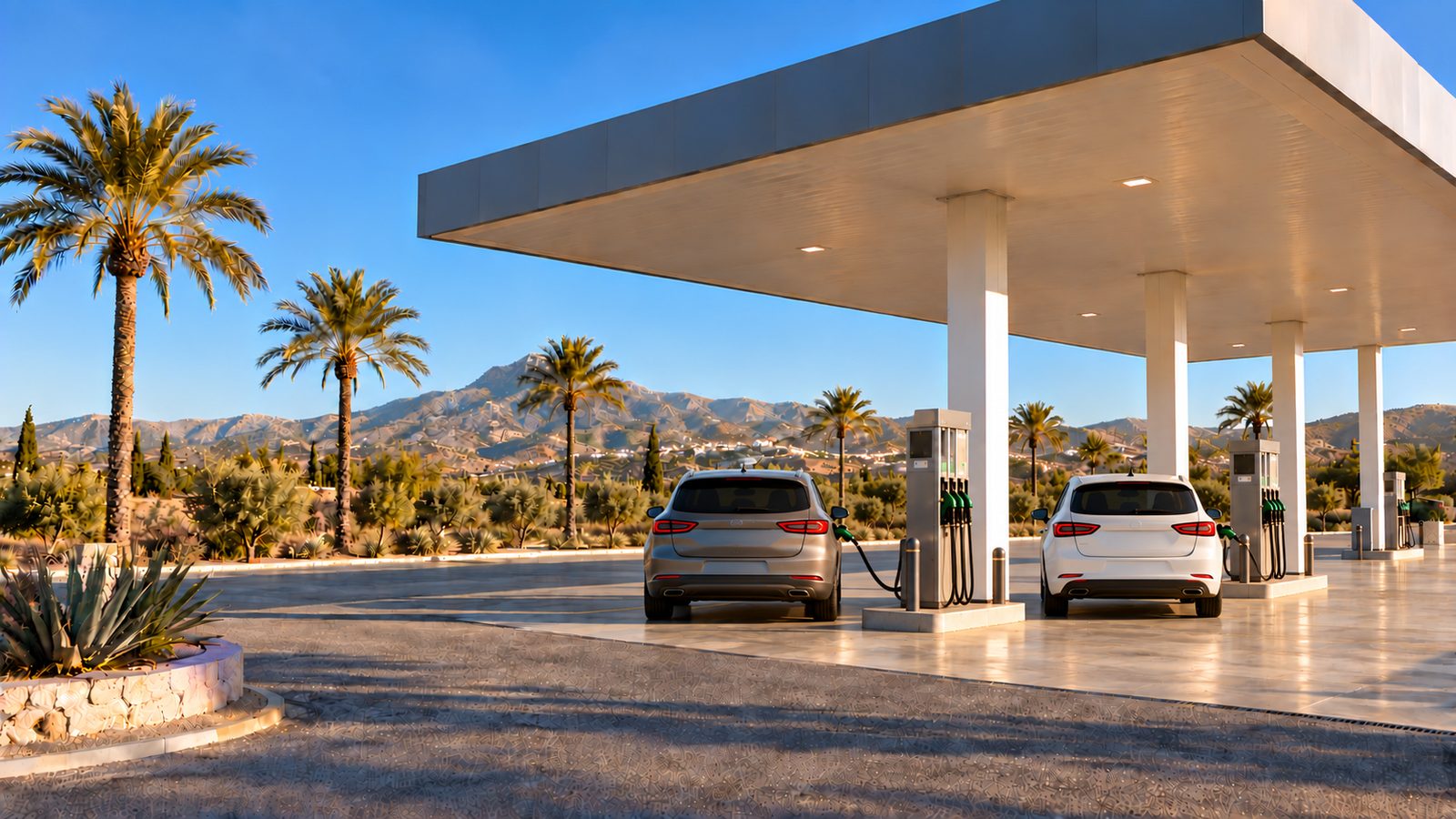
Buying petrol in Spain is not quite like filling up at home. At a Spanish “gasolinera” (petrol station) the fuels have different names, and you often pay in a different way. The price gap between a motorway station and an unmanned pump three kilometres away can reach 20 cents a litre. On a full tank, that is ten euros or more either way.
There is one more thing you do not want to learn the hard way. Putting petrol in a diesel rental car costs you €500 plus the actual cost of the repair. This guide covers what Spanish fuels are called, what you really pay in August 2026 and how an unmanned station works. It also tells you what to do if you grab the wrong nozzle after all.
In this article:

Let's start at the pump, because this is where most mix-ups begin. The words “petrol” and “unleaded” appear nowhere on a Spanish nozzle. You will see these instead:
The easiest way is to remember two words. Petrol is gasolina, diesel is gasóleo. They look alike and mean completely different things. The EU fuel labels help too, and they are the same ones you see on UK and Irish forecourts. Petrol carries a circle with E5 or E10, diesel a square with B7. Still not sure? Look inside the fuel flap, where most cars state exactly what goes in the tank.
Spain is one of the cheaper countries in Western Europe for fuel. National average prices in mid-August 2026:
| Fuel | Spanish name | Average price, € per litre |
|---|---|---|
| Petrol 95 | Gasolina 95 | approx. 1.77 |
| Petrol 98 | Gasolina 98 | approx. 1.92 |
| Diesel | Gasóleo A | approx. 1.90 |
| Premium diesel | Gasóleo A+ | approx. 1.99 |
| LPG | GLP | approx. 1.13 |
Those are national averages. Your real price depends on where you pull in with an empty tank, and here the spread gets serious.
The big brands have the densest network, staff on site, a shop, coffee and toilets. You pay for the convenience. Prices sit around the national average or slightly above. On a drive across Andalusia you pass one every dozen kilometres or so. That makes them the safe choice when the fuel light comes on.
This is where it gets interesting. These stations are fully unmanned, often with no building at all, just a payment terminal and a few pumps. The fuel comes from the same refineries, and the price is often 10 to 20 cents a litre lower. With a 50-litre tank you save €5 to €10 every time you fill up.
You find them mainly on the edge of towns and on access roads, less often on the motorways themselves. There are plenty in Malaga, Marbella, Fuengirola and Torremolinos. On a longer drive, fill up along the way, not at the last minute.
Carrefour, Alcampo and Eroski run their own stations next to their shopping centres. Think supermarket fuel, Spanish style. Prices are competitive, usually between low-cost and premium. A good choice if you are stopping for shopping anyway.
At the other end are the stations on the motorways themselves and by the airport. There you pay as much as 15 to 25 cents more per litre than at an unmanned pump a few kilometres away. When you return a car at Malaga airport, this is the most common trap. Fill up earlier, in town or by your exit, not in the last kilometre.

An unmanned gasolinera is only daunting the first time. If you have used pay at pump at home, you already know half of it. The routine is always the same.
Foreign Visa and Mastercard cards work without trouble. So does Revolut. Some terminals take no cash at all, so a card may be your only option at an unstaffed station after hours.
Real numbers beat generalities, so let's do the maths. The table below assumes a compact car using about 6 l/100 km and €1.77 per litre for Gasolina 95. Distances are round trips, out from Malaga and back.
| Route (round trip) | Distance | Fuel | Cost |
|---|---|---|---|
| Malaga to Nerja | 114 km | approx. 6.8 l | approx. €12 |
| Malaga to Caminito del Rey | 130 km | approx. 7.8 l | approx. €14 |
| Malaga to Ronda (A-357) | 220 km | approx. 13.2 l | approx. €23 |
| Malaga to Granada | 252 km | approx. 15 l | approx. €27 |
| Malaga to Gibraltar | 260 km | approx. 15.6 l | approx. €28 |
| Malaga to Seville | 410 km | approx. 24.6 l | approx. €44 |
How to read it: a day trip to Ronda costs €23 in fuel, not the €60 many people assume before they travel. Even Seville, the furthest of the popular destinations, costs about the same as two one-way bus tickets. Parking and any motorway tolls come on top. Still, fuel is rarely the biggest item in a day-trip budget.
A diesel burns less, especially on long motorway stretches. At €1.90 a litre, though, the saving in your wallet is smaller than the consumption figures suggest. A hybrid wins in town, in the traffic on the Torremolinos seafront or while you circle for a space in central Malaga.
The Spanish ministry responsible for energy runs an official fuel price comparison site. Every station in the country must report its prices, and the site shows them on a map in near real time. The data is official, not marketing, so it is the most reliable source.
In practice, apps are handier. Several show the stations around you, sorted by price for the fuel you choose. Planning a longer drive? Set the filter to Gasolina 95 or Gasóleo A and check the stations at the exit where you will stop anyway.
A simple holiday rule: fill up in town or on the outskirts. Never on the motorway and never at the airport, unless you really have no choice.
Check in three places, in this order:
Most cars in our fleet run on petrol, some of them as hybrids. A hybrid takes ordinary Gasolina 95, needs nothing special and never has to be plugged in.
It happens. Especially when you are tired after a flight, or at an unfamiliar station late in the evening. Only one thing matters.
Do not start the engine. While the wrong fuel sits in the tank, the problem can be contained. Once the engine runs, the fuel travels into the injection system, and the repair stops being cheap.
What to do, in order:
You know the cost in advance. Under our rental terms, filling up with the wrong fuel costs €500 plus the actual cost of the repair. One more thing: even the widest insurance package does not cover it, because wrong-fuel damage is expressly excluded. We break down what each option covers in our guide to rental car insurance in Spain.
There is good news too. Petrol in a diesel is more dangerous than diesel in a petrol car, and most rental cars run on petrol. A diesel filler neck also tends to be wider, so the slim petrol nozzle slides in easily, but not the other way round. Physics is quietly on your side, though not always.
The most common arrangement at rental companies on the Costa del Sol is “full to full”. You collect the car with a full tank and you return it full.
Plan your last fill 10 to 20 km before the drop-off point. The gauge will still read full, and you will not pay the airport price. Keep the receipt, it helps in any dispute about the fuel level.
Returning the car at night or at your hotel? Fill up earlier, during the day. Some low-cost stations are open round the clock, but not all. Hunting for an open gasolinera at two in the morning is no way to end a holiday.
Gasolina 95, sometimes labelled Sin Plomo 95 or SP95. “Sin plomo” means unleaded.
Gasóleo A is ordinary diesel for passenger cars. Gasóleo B is dyed agricultural diesel for farm machinery, and you must not put it in a car.
At the unmanned Petroprix, Plenoil and Ballenoil stations, usually 10 to 20 cents a litre cheaper than the big brands. Motorway and airport stations are the most expensive.
Yes. Visa and Mastercard are accepted everywhere, and Revolut works too. The terminal holds €50 to €150 up front, and the final amount settles within one to three days.
Some are. Part of the unmanned low-cost network runs round the clock, but not every station does. Some terminals take cards only, so carry one after hours.
With a 50-litre tank and Gasolina 95 at about €1.77 a litre, you pay roughly €88. At a low-cost station it is closer to €80, on the motorway as much as €96.
About €23 for the round trip in a compact car using 6 l/100 km. That is 220 km in total and roughly 13 litres of Gasolina 95.
Do not start the engine and call the rental company straight away. Under our rental terms the charge is €500 plus the repair cost, and insurance does not cover it.
You now know gasolina from gasóleo and where to fill up without overpaying. All that is left is the car. At Car4Rent Malaga you rent with no deposit and no credit card, with service in English or Polish around the clock. We bring the car to the airport terminal, or to your hotel for a delivery fee. The paperwork takes 15 to 20 minutes.
➤ Check availability and prices
See also:
 Contact phone number/Whatsapp:
 E-mail:
 Opening hours:


