
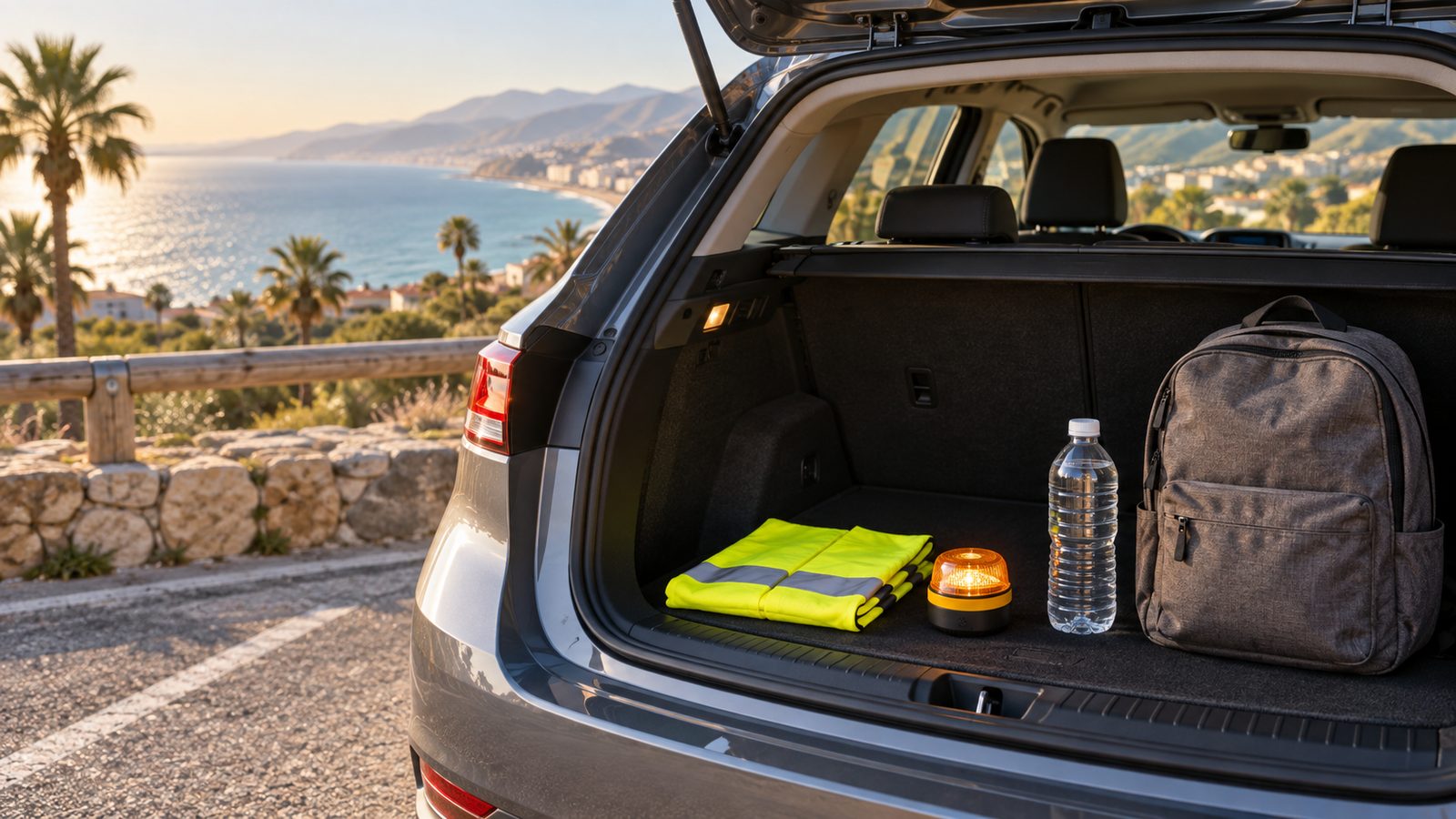
Since 1 January 2026, every Spanish-registered car has to carry a flashing V-16 beacon instead of a warning triangle. Your rental car has Spanish plates too, so the rule applies to you from the first kilometre out of Malaga airport. Add a hi-vis vest inside the cabin, a full set of documents and a few things no law asks for. Without them, a July day on the A-7 will wear you out more than the flight did.
This guide separates what is mandatory from what is simply handy. You get a 15-point driving in Spain checklist, with prices and fines. You also find out what is already waiting in a Car4Rent Malaga car and what you pack yourself.
In this article:
Five items come from the law or from your rental agreement. The other ten come from experience on Andalusian roads, not from any rulebook.
Mandatory (law or rental agreement):
Recommended (nobody will fine you, but you will regret skipping them):
Not on the list, but easy to forget if you fly in from the UK or Ireland: a travel adaptor. Spain uses type C and F sockets, so three-pin plugs will not fit. Visitors from mainland Europe can skip it.
The V-16 beacon is a small magnetic light that goes on the roof if you break down. The “conectada” (connected) version talks to DGT 3.0, the platform run by the DGT, Spain's traffic authority. Since 1 January 2026 it has been the only legal warning device in cars registered in Spain. Cars, vans, buses, lorries. Motorcycles are exempt.
Why must a rental car have one? Because it is registered in Spain. The rule looks at the number plates, not at the driver's passport. Bring your own car on foreign plates and you carry on with warning triangles (Vienna Convention, confirmed by the DGT). In a rental car the beacon must be on board. A missing beacon, or a model without official approval, means an €80 fine. Not 200, as some posts claim. It is a minor offence, but the stop will still cost you half an hour of your holiday.
It takes a few seconds, and that is the whole advantage over a triangle. You do not have to walk 50 metres back along the carriageway.
The light shines through 360 degrees, lasts at least 30 minutes and can be seen from about a kilometre away. At the same moment the beacon sends your position to DGT 3.0. The warning then shows up on other drivers' sat navs and on the overhead signs. No app, no SIM card to sort out. Connectivity is prepaid for at least 12 years.
A triangle does not replace the V-16 in a Spanish car, but it is not banned either. The head of the DGT put it in one sentence in December 2025: “the triangle is not banned, the beacon is mandatory”. Find both in the car? Fine. Only a triangle? Ask the staff where the V-16 is before you leave the car park.

A hi-vis vest has been mandatory since 2004 (Article 118 of Spain's general traffic regulations). You put it on before you step onto the carriageway or the hard shoulder outside built-up areas. A breakdown, a bump, a wheel change. Owning one is not the point. Wearing it when you get out is.
That tells you where to keep it. In the cabin: the driver's door pocket or the glovebox. Not in the boot. To fetch a vest from the boot you get out without a vest, which is exactly the situation the rule is there to prevent.
How many vests? The law asks for one, for the driver. The DGT and the Guardia Civil recommend one per person. At prices from €3, it is hard to argue against. Look for the CE mark and the EN ISO 20471 standard.
The fine for stepping onto the road without a vest goes up to €200 (€100 with the early payment discount, “pronto pago”). For simply not having a vest in the car, fines tend to be lower, around €80 to €100.
The internet is full of lists that make a Spanish car look like an ambulance. According to the Guardia Civil's traffic unit (2026), none of these is mandatory in a passenger car:
About that wheel: the law does not require one, but physics does. At pick-up, check what your rental car has: a space-saver spare or a repair kit with a compressor. Knowing where it is kept saves your nerves on the hard shoulder of the A-357 on the way to Ronda.
Simple stuff, and yet every year someone leaves their passport in the hotel safe.
Your driving licence. A licence from any EU country is valid across Spain, and you do not need an international permit with it. UK visitors can drive in Spain on a photocard licence, and gov.uk confirms that no international driving permit (IDP) is needed. Provisional licences are not valid. At Car4Rent Malaga the driver must be at least 25 and have held a licence for at least 2 years. An additional driver shows their own licence at pick-up.
Passport or national ID card. You need it at pick-up and at a roadside check. UK visitors travel on a passport, and EU citizens can use a national ID card instead. A photo of it on your phone does not replace the original.
Car documents and rental agreement. In the car you should find the “permiso de circulación” (registration certificate). With it comes the “tarjeta ITV” or “ficha técnica” (the technical inspection card, Spain's version of the MOT certificate). The Guardia Civil accepts copies and digital versions. You do not need paper proof of insurance, because the officer checks it in the FIVA database. Keep the rental agreement in the glovebox or on your phone. Without it, proving that the car is rented gets harder.
You do not need a Green Card either. That document is for people who bring their own car from abroad. What the cover on a rental car includes is explained in our guide to rental car insurance in Spain.
The Car4Rent Malaga rental terms say the car comes with “vehicle equipment in line with the applicable law of the Kingdom of Spain”. So a connected V-16 beacon, a hi-vis vest and the full set of vehicle documents should be waiting in the car. Air conditioning is standard in every car in the fleet.
Your job at pick-up comes down to three questions: where is the V-16, where is the vest, where are the documents. The paperwork takes 15 to 20 minutes, and the staff speak English and Polish.
There is one more reason to ask. The rental terms set a charge of €100 for each missing or damaged item of standard equipment at return. If the beacon was never in the car, you want to know before you leave the car park, not when you hand back the keys. The airport pick-up itself, minute by minute, is in our guide to renting a car at Malaga airport.

That is the law dealt with. Now for what really decides how comfortable your week on the Costa del Sol is.
Phone holder. A phone in your hand while driving costs €200 and 6 points. A holder at around €10 to €25 is the best money you will spend on this list.
Charger and cable. Sat nav with the screen on drains the battery faster than you think. Take a 12 V charger or a power bank, plus the cable everyone forgets.
Offline maps. Download the map of Andalusia and save the addresses of your hotel, beaches and car parks. In the hills behind Marbella the signal drops without warning.
Water. Summer 2026 was Spain's hottest since 1961 (AEMET, the national weather agency), with temperatures up to 42 degrees. A litre per person is the minimum. Never leave children or animals in the car, not even for a moment.
Windscreen sunshade. Around €5 to €15. After two hours on the beach, the steering wheel will not burn your hands.
Coins and a card. More and more parking meters in the “zona azul” (blue zone) refuse cash, but not all of them. In Malaga the SARE zone runs on weekdays from 9:00 to 14:00 and 16:00 to 20:00, and on Saturdays from 9:00 to 14:00. The maximum stay is 150 minutes.
Parking app. Telpark, EasyPark or ElParking. Add your card at home, not on a pavement in 38 degrees.
GHIC or EHIC, plus travel insurance. The card (GHIC for UK residents, EHIC for EU residents) gets you into state healthcare. It does not cover private clinics or getting you flown home. Travel insurance closes that gap.
Sunglasses. At 18:00 the sun over the A-7 shines straight into your eyes. Not a luxury, equipment.
Photos of the car at pick-up. Bodywork from all four sides, wheels, interior, mileage, fuel gauge. Two minutes that settle most disputes at return. Details are in our guide to returning a rental car in Malaga.
Most of this you can buy at home for similar money, and you will not lose holiday time hunting for a shop.
| Item | Where to buy | Guide price |
|---|---|---|
| Hi-vis vest (EN ISO 20471, CE) | hypermarket, car accessories shop, Norauto | from €3 (€1 to €5) |
| Phone holder | electronics shop, petrol station | around €10 to €25 |
| Windscreen sunshade | hypermarket, petrol station | around €5 to €15 |
| Connected V-16 beacon | only for your own Spanish-registered car | €28 to €40, premium up to €60 |
A note on the last row. You do not buy a V-16 for a rental car, because the rental company has to supply it. You only buy one for your own car on Spanish plates, and only from the list of approved models on dgt.es. The list has more than 200 entries, and the certificate number is printed on the device. At Carrefour you pay from €28.68 to €39.99.
Guardia Civil checks are frequent on the A-7 in summer. Got everything on the checklist? It takes a few minutes.
Alcohol. The limit is 0.25 mg/l in breath, which is 0.5 g/l in blood. For drivers who have held a licence for less than 2 years it is 0.15 mg/l. The cut to 0.2 g/l reported in the media never came into force. Congress rejected it on 18 March 2026. A reading of 0.25 to 0.50 mg/l means €500 and 4 points. Above 0.50 mg/l it is €1,000 and 6 points, and from 0.60 mg/l it becomes a criminal offence. The breath test and the rental car angle are covered in our guide to drink driving in Spain in 2026.
Drugs. A saliva test on the spot. A positive result means €1,000 and 6 points, and refusing the test is a criminal offence.
Phone. €200 and 6 points for a device in your hand. Hence the holder on the list.
Numbers to save before you travel: 112 (emergencies, English spoken), 062 (Guardia Civil), 011 (DGT road and traffic information). The full list of rules, speed limits and fines is in our guide to traffic rules in Spain 2026.
Yes. Since 1 January 2026 every Spanish-registered car must carry a connected V-16 beacon, and a rental car has Spanish plates. The rental company supplies it, you check where it is kept.
No. In a rental car the company provides the beacon, and a car on foreign plates can keep using warning triangles. You only buy a V-16 for your own Spanish-registered car.
€80 for a missing device or a model without DGT approval. It is a minor offence, not €200 as some websites say.
One, for the driver. The DGT and the Guardia Civil recommend one per person, because anyone who steps onto the hard shoulder outside built-up areas must wear one.
No. According to the Guardia Civil's traffic unit, in 2026 the only mandatory equipment is the V-16 and the vest. A fire extinguisher, first aid kit, spare bulbs and spare glasses are not required.
No, not with a licence from an EU country or a UK photocard licence. Gov.uk confirms that UK visitors do not need an IDP in Spain. Car4Rent Malaga asks for a minimum age of 25 and a licence held for 2 years.
You check the V-16 beacon, the vest and the vehicle documents at pick-up. All you add yourself is the second half of the list. At Car4Rent Malaga you rent with no deposit and no credit card, with service in English or Polish around the clock. We bring the car to the terminal at Malaga airport at no extra charge, or to your hotel for a fee. Mileage within Andalusia is unlimited.
➤ Check availability and prices
See also:
 Contact phone number/Whatsapp:
 E-mail:
 Opening hours:


